Positions and Commentary
Website Guide and Notes
After roughly two weeks of testing, my independent molecular-anthropology research website, Mediterraneism.com, is now officially online. Below I will introduce several of its most important pages.
I. Hypothesis
The site’s most valuable content is also the preliminary result of my current research and may be regarded as the framework that will guide its future direction. The full English edition of The Far Eastern Paleo-Mediterranean Ghost Hypothesis—roughly 60,000 Chinese characters in its original form—will be published on the HYPOTHESIS page. The Chinese PDF, which is the original edition, can be downloaded directly by clicking the square module on that page.
Page: https://mediterraneism.com/hypothesis/
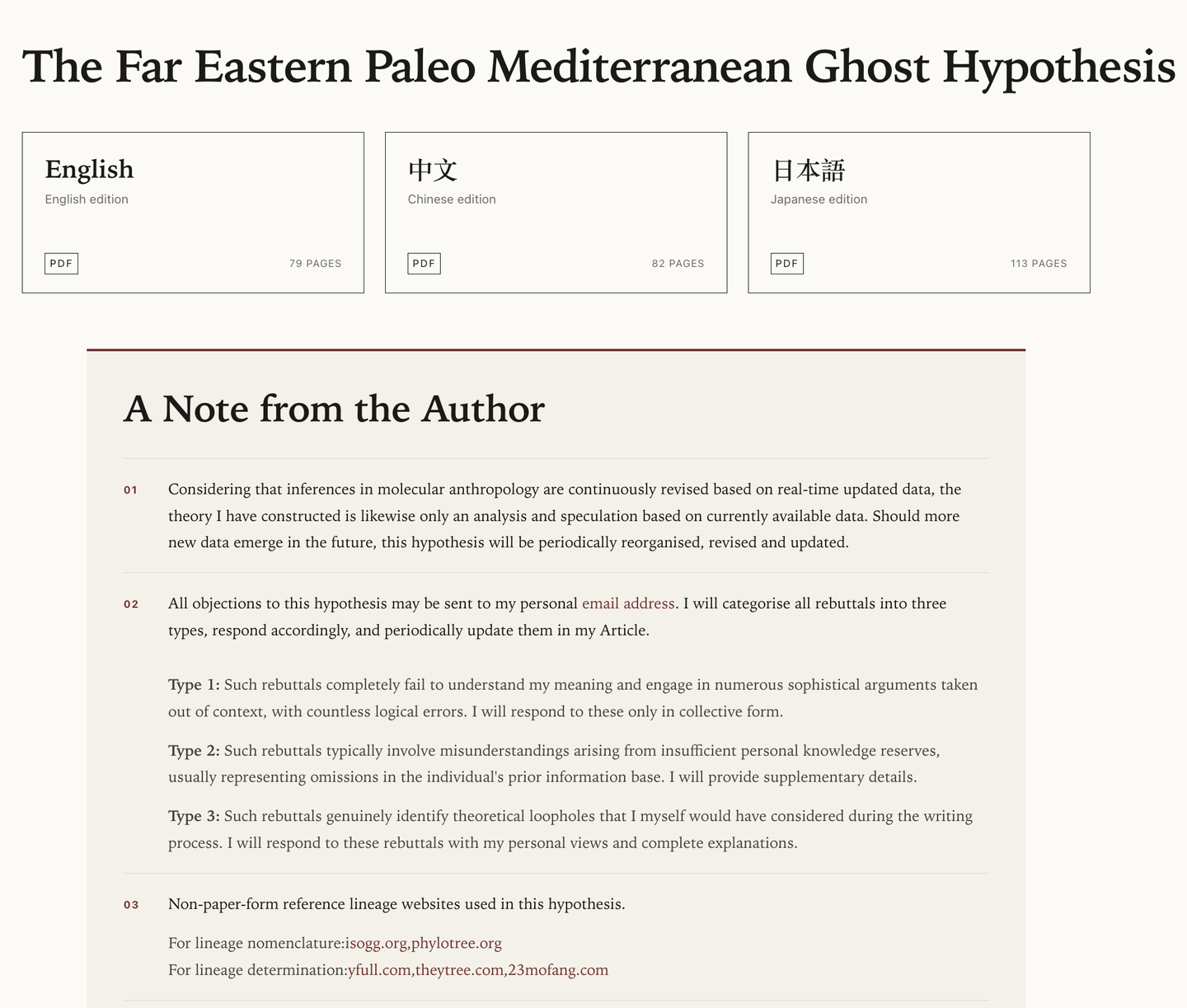
This is the site’s most valuable content because I do not currently intend to publish the hypothesis in full on any other public platform. The website is therefore the only place where the complete text can be read. This both protects a new theory and provides an initial means of filtering its readership.
Readers are welcome to contact me by email or through my other contact channels with any questions or objections, and I will respond accordingly. As I explain in “A Note from the Author” on that page, however, I divide critical responses into three categories:
Type 1: These responses completely misunderstand my argument and rely heavily on sophistry divorced from context, often containing elementary logical errors. I will address them only briefly and in collected responses.
Type 2: These responses generally arise from misunderstandings caused by gaps in an individual’s knowledge. They usually reveal missing information in the critic’s own knowledge base, so I will provide the relevant supplementary information and clarification.
Type 3: These responses identify genuine weaknesses in my theory—issues that I also considered while writing it. I will answer such criticisms seriously, presenting my own reasoning and the most complete explanation I can currently offer.
After two years of online debate, however, I have increasingly come to believe that argument is far less valuable than constructing and disseminating a theory. Most people ultimately cannot fully understand what one is trying to say, because following an argument requires grasping its entire logical structure and all of its prerequisite information. The cost is particularly high in a new discipline such as molecular anthropology: truly understanding the work can require retracing the researcher’s entire path. As a result, many interpretations are accompanied by misunderstandings of both concepts and lines of reasoning, and debate conducted on that basis has limited value.
The one practical course is to circulate one’s ideas as widely as possible. Even supporters may not fully understand the theory, but broader circulation at least increases the chance that it will reach and inspire genuinely perceptive people who might otherwise remain unseen. I will therefore gradually reduce the time I devote to answering rebuttals and put more energy into other work. Because I naturally enjoy debating with others, I will not stop altogether; it will simply occupy a smaller part of my attention.
II. Ancient DNA
The next most important section is the ANCIENT DNA page. It collects every published ancient sample assigned to paternal haplogroup D‑M174 and displays all of them on a map. I believe it is currently the most comprehensive collection of its kind on the internet, since other comparable websites omit at least some samples. Whenever a new sample is published, I will try to update the database promptly and add it manually.
On the ANCIENT DNA page, samples can be found by searching for keywords in their identifiers, paternal or maternal haplogroups, publication titles, archaeological sites, and other fields. To the right of the search box is a timeline labelled “Older than all ages.” Adjusting it reveals the distribution of samples from more recent to earlier periods. Moving it farther to the right displays fewer samples, but these older samples are generally more significant. I have also created separate options for the principal branches, making it easy to display samples from a selected lineage.
Page: https://mediterraneism.com/ancient-dna/
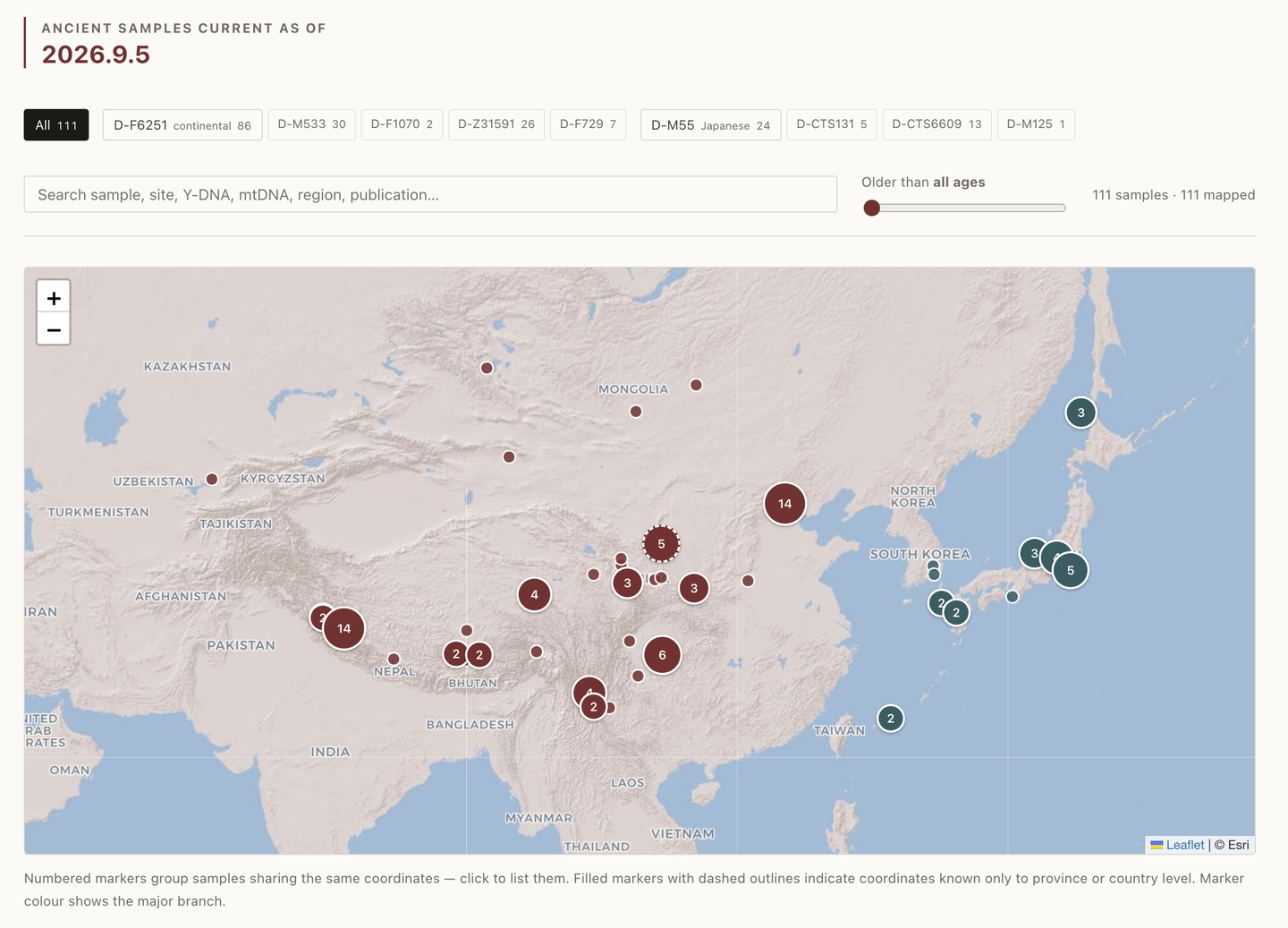
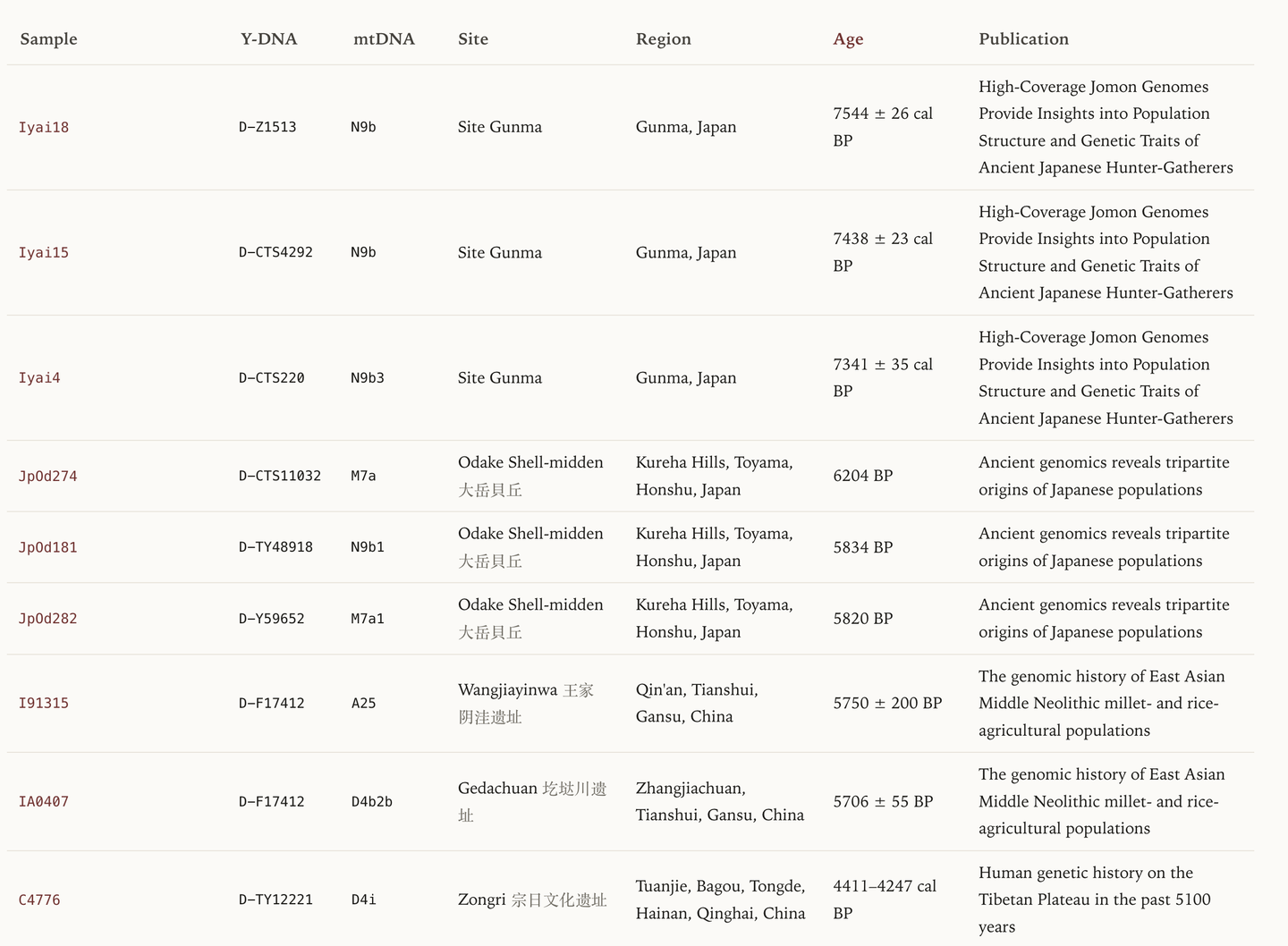
Below the map, the ancient samples are arranged by date, from the earliest to the latest. The displayed information includes the sample identifier, paternal and maternal haplogroups, excavation site and location, date, and original publication. The page includes every currently published sample in the database.
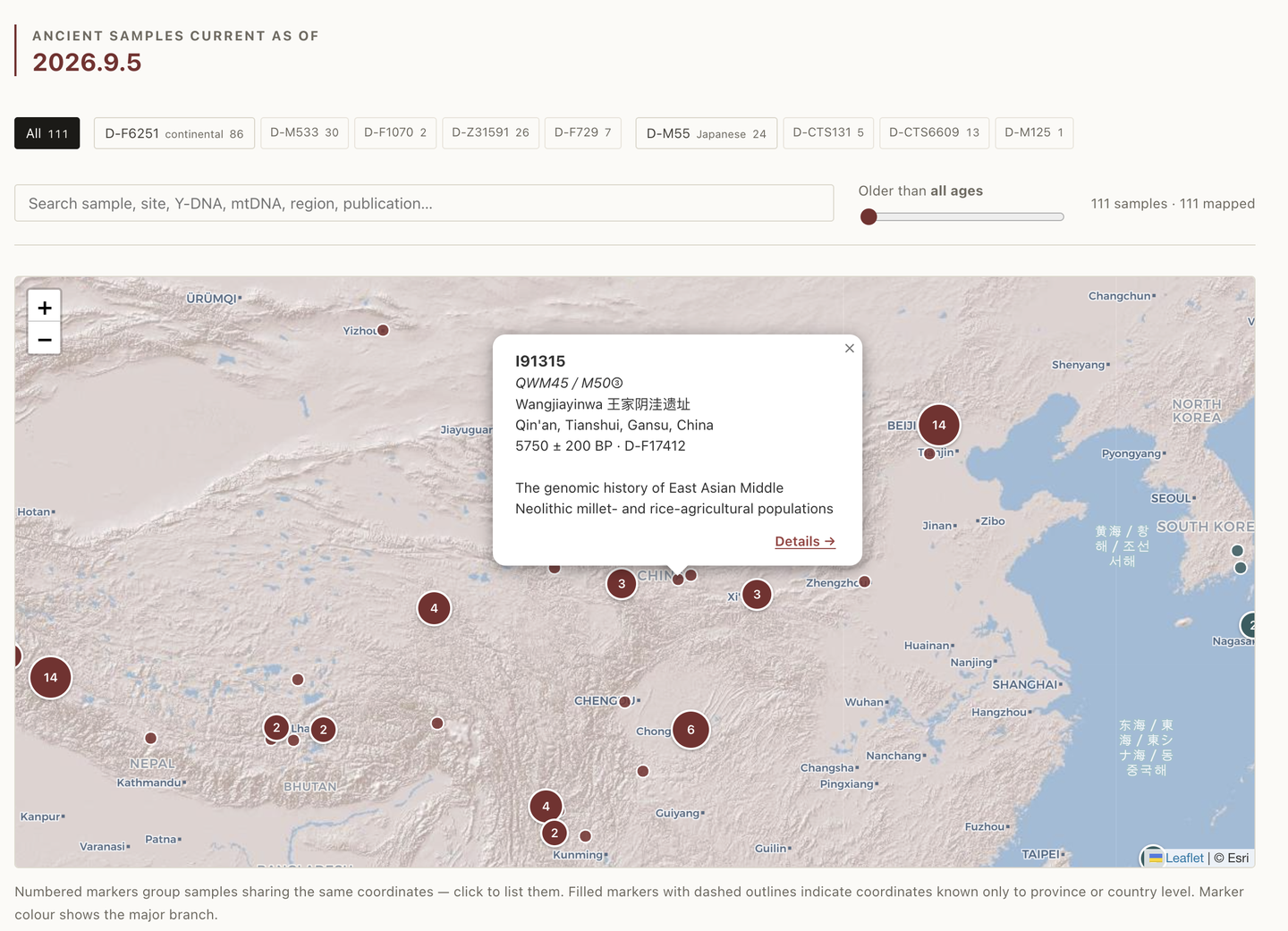
The map can be zoomed in and out. Clicking any sample marker displays its information, while selecting “Details” opens a more comprehensive record. The sample I91315 from the Wangjiayinwa site is shown here as an example.
Clicking “Details” opens the ancient sample’s individual information page, again illustrated here with I91315 from Wangjiayinwa.
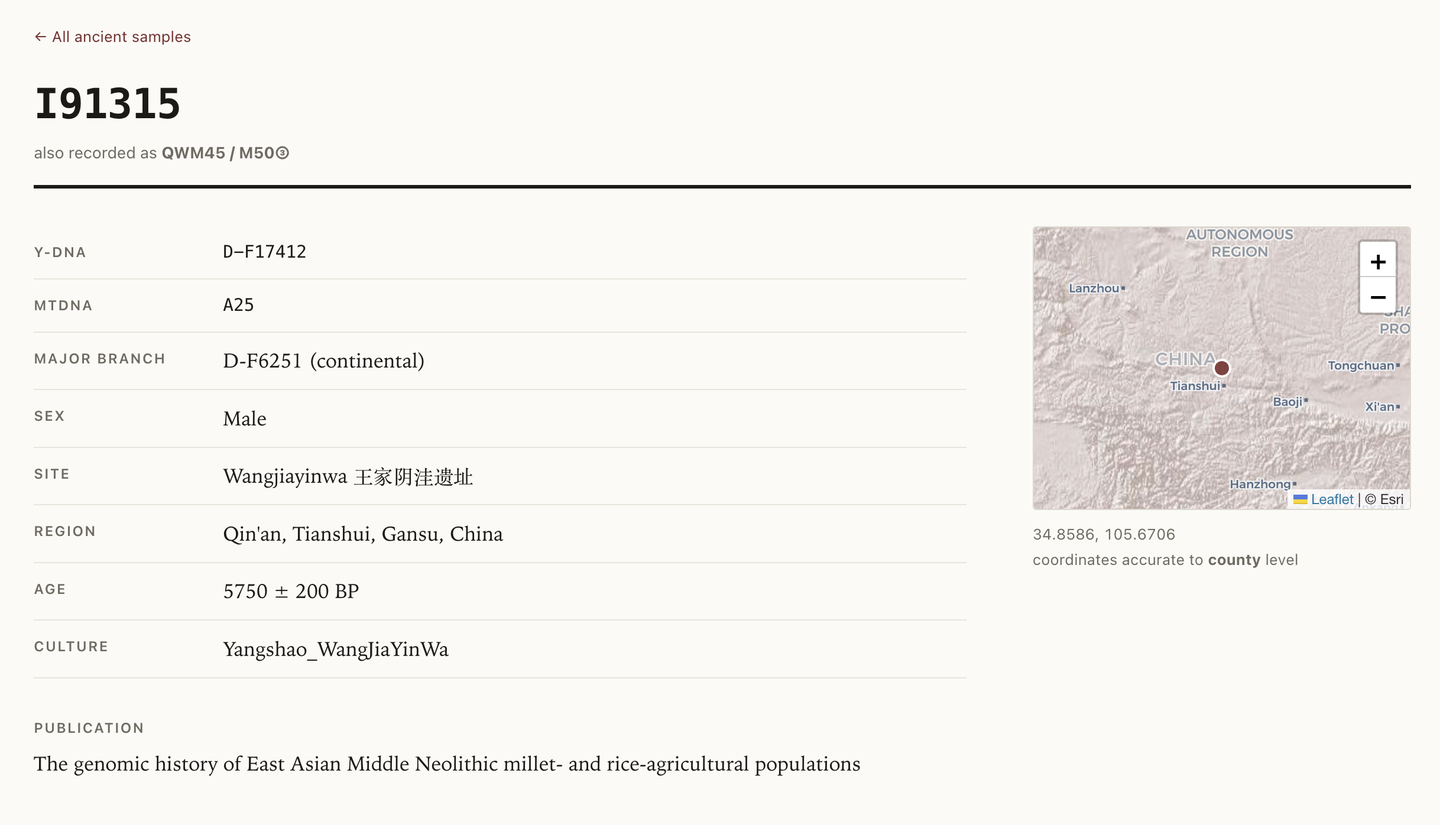
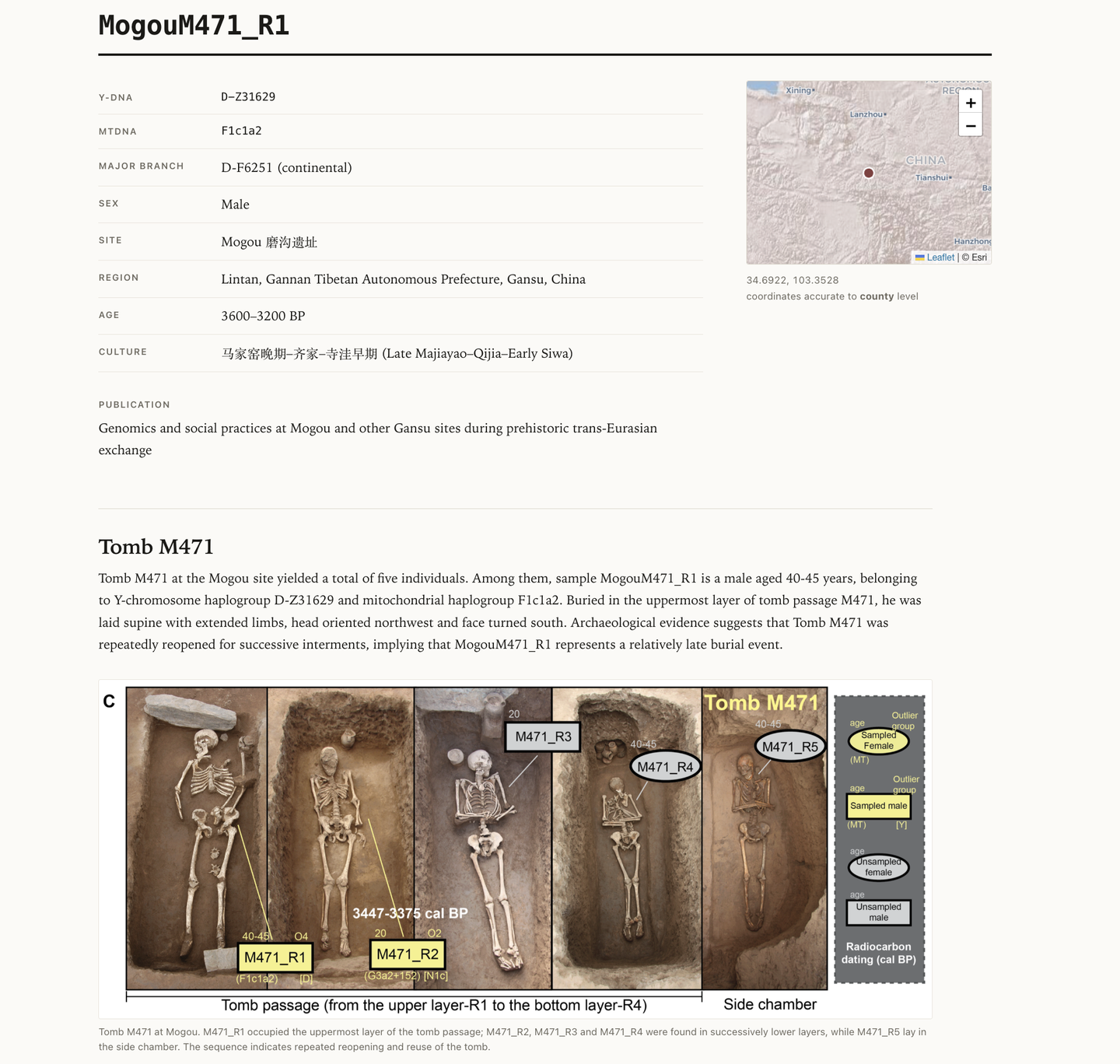
When I collect additional information about an ancient sample, I place it below the standard fields on that sample’s detail page. By “additional information,” I do not mean widely known data such as autosomal ancestry components, but comparatively obscure material found only in supplementary appendices or in sources that are not readily accessible to the public. These records will continue to be expanded as more information becomes available. Contextual material has already been added for MogouM471_R1, XiahaishiM22, Funadomari5, AKG_10203, XSM-M128-1, Shengjizui, TAH002, MabucoSM26_2, LJM25, and other samples. The recently updated MogouM471_R1 record is shown below as an example.
III. Articles and Posts
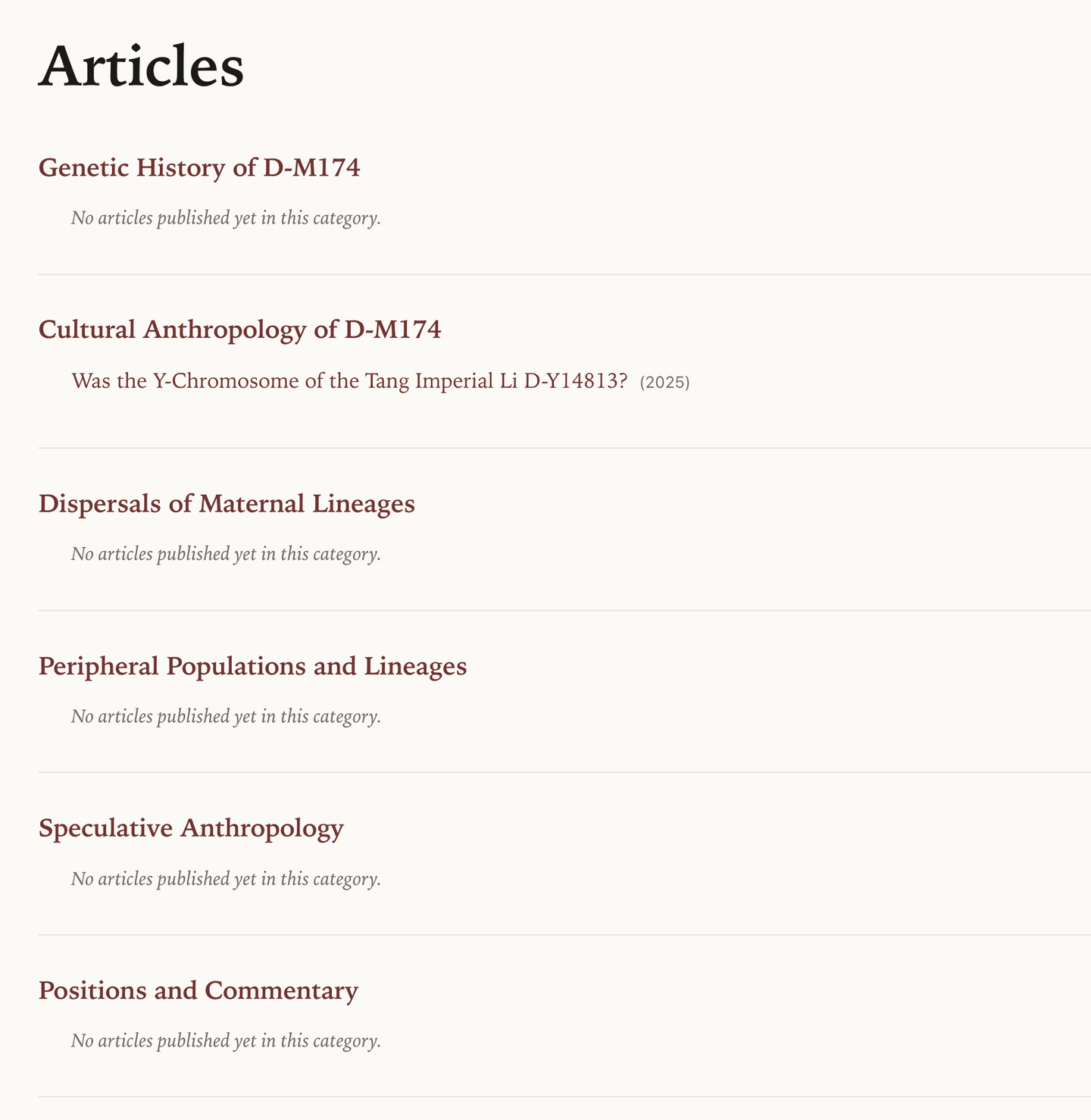
The ARTICLE and POST pages contain all of my published articles, answers, and shorter posts. These items are also synchronized with my Zhihu account, so in principle readers do not need to visit the website specifically to view them. Even so, classifying and preserving them on the site in English remains necessary.
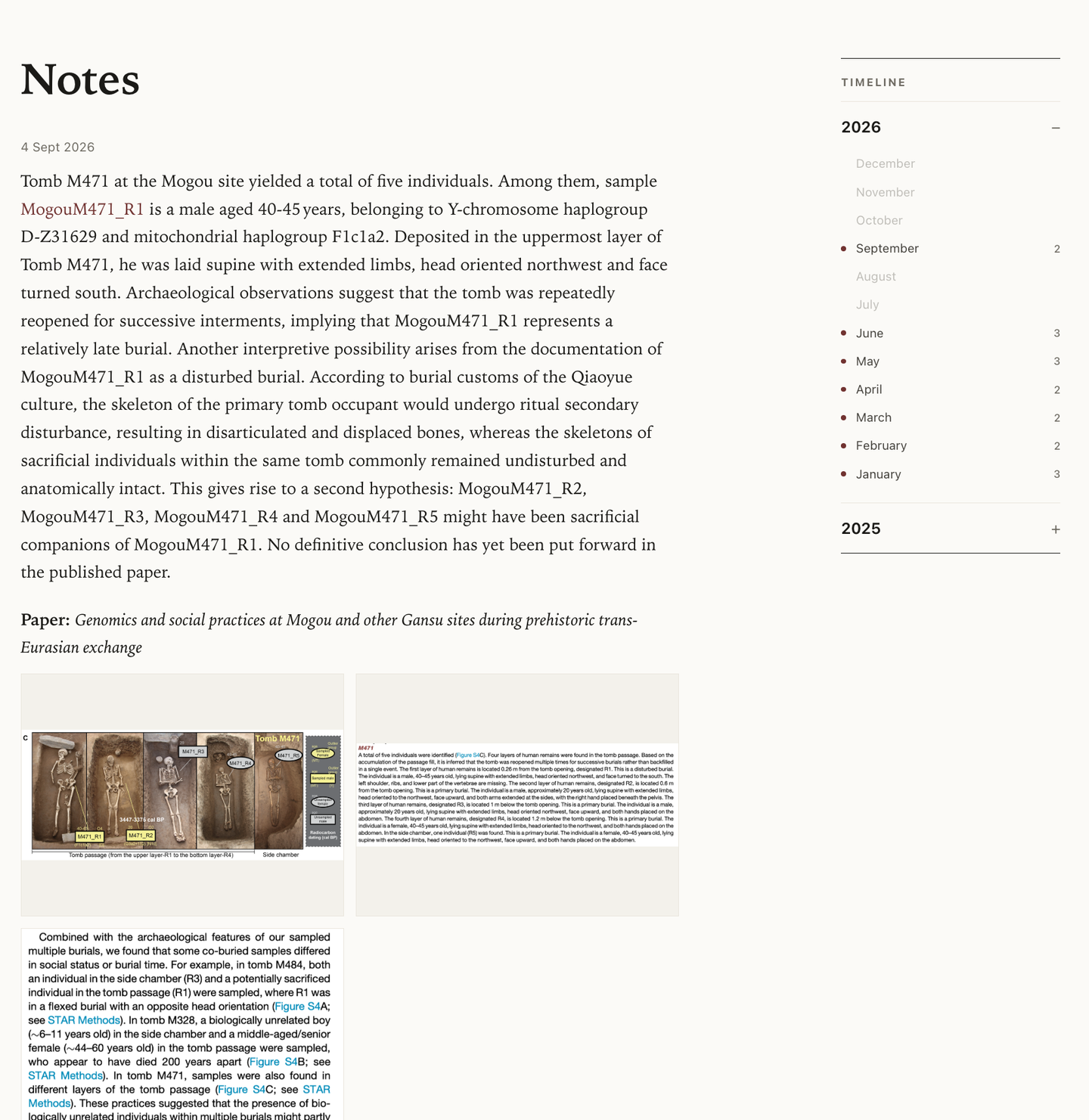
On the right side of the POST page is a timeline that provides direct access to posts from different years and months. Because this website is intended to operate permanently—on a timescale of decades at minimum—the timeline will, in my view, become increasingly important as the archive grows.
IV. Papers and Scholars
Two pages on the website are devoted entirely to material produced by others. The PAPER page continuously collects publications found through a range of keywords. These molecular-anthropology papers are indispensable to the research.
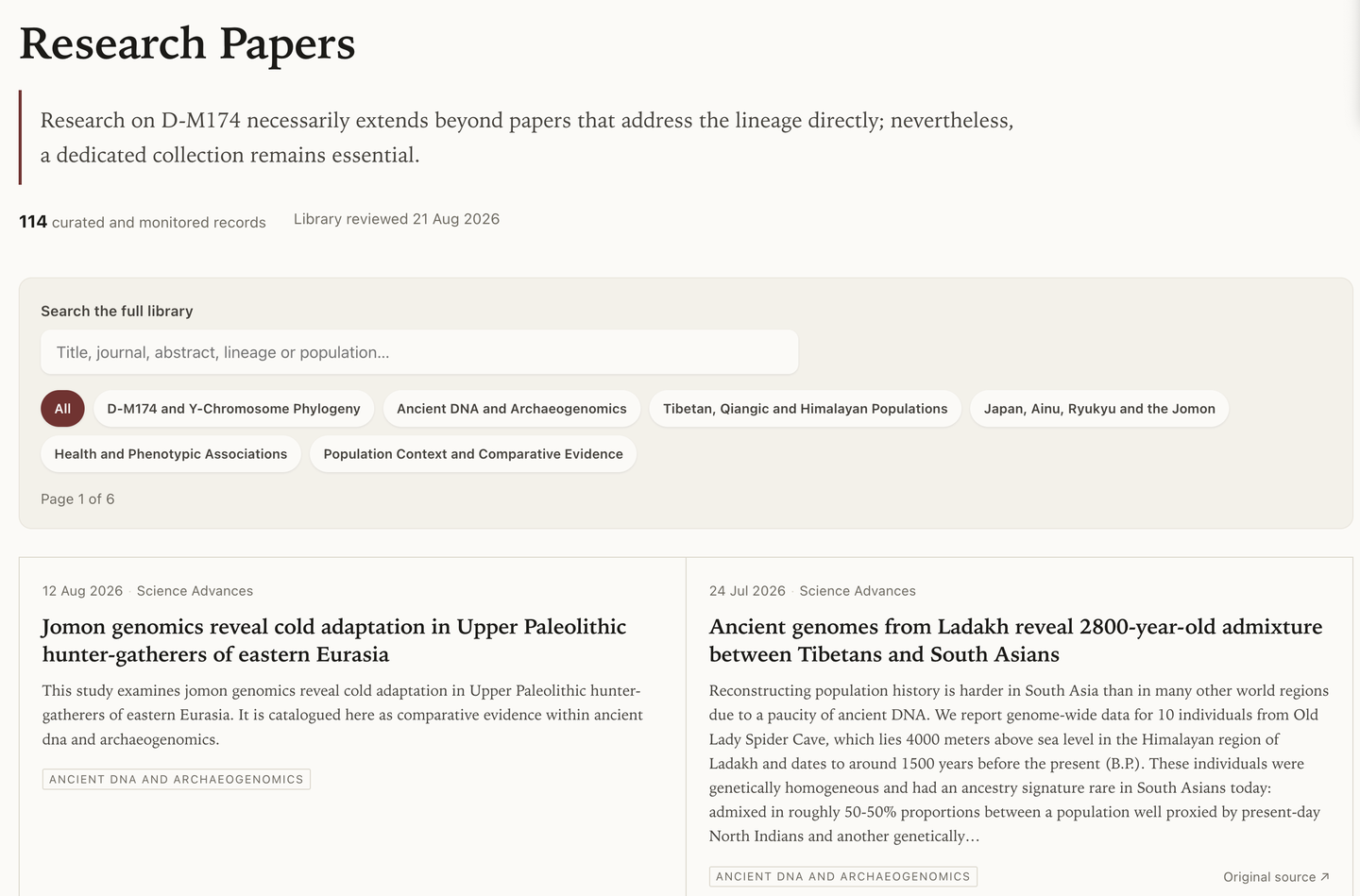
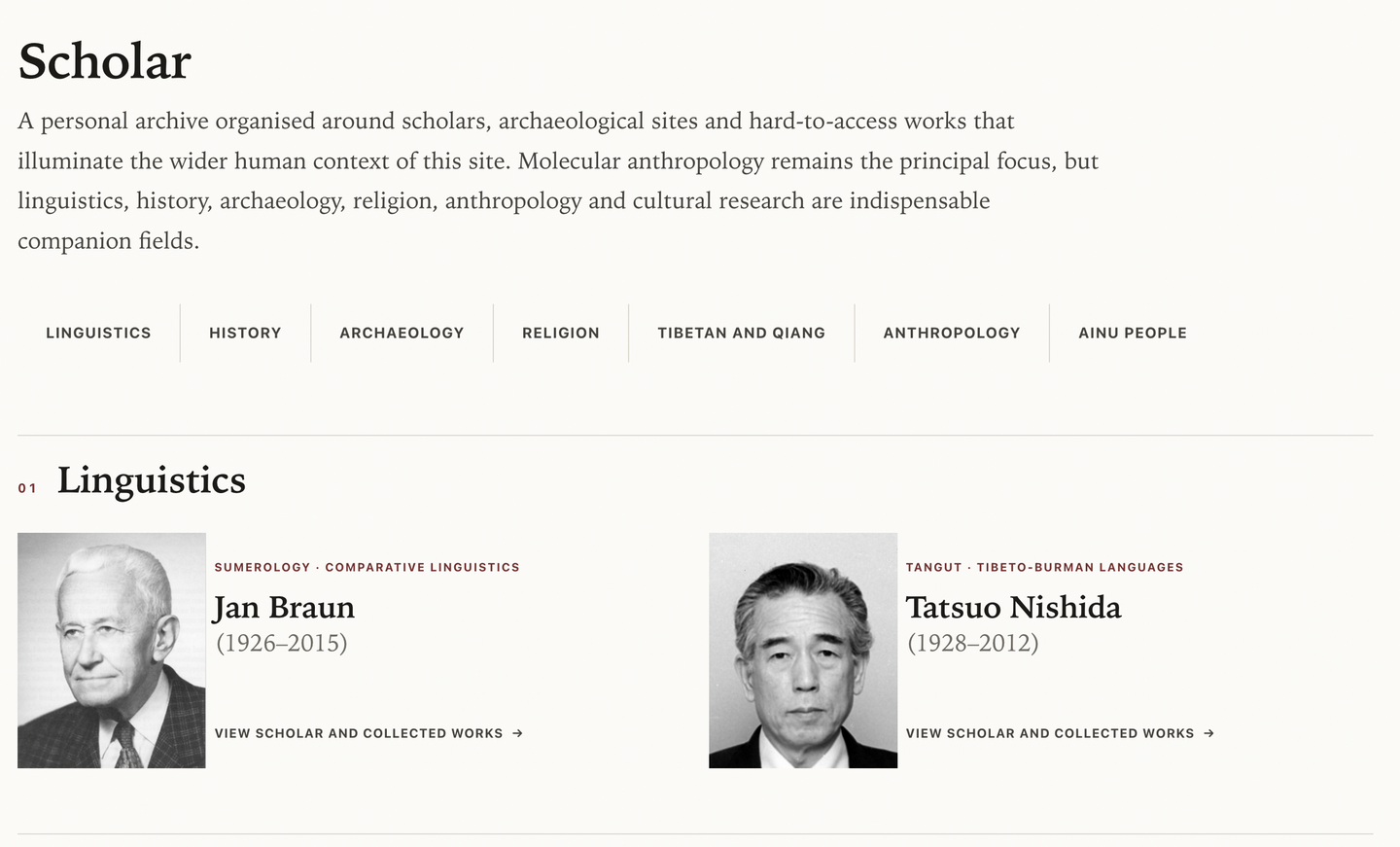
Molecular anthropology alone, however, is not enough. Research must also draw on earlier work in cultural anthropology, linguistics, archaeology, history, and related disciplines. Material that may appear outdated can acquire enormous potential when combined with molecular anthropology. I will therefore continue collecting relevant scholars, classifying them, and adding them to the SCHOLAR page.
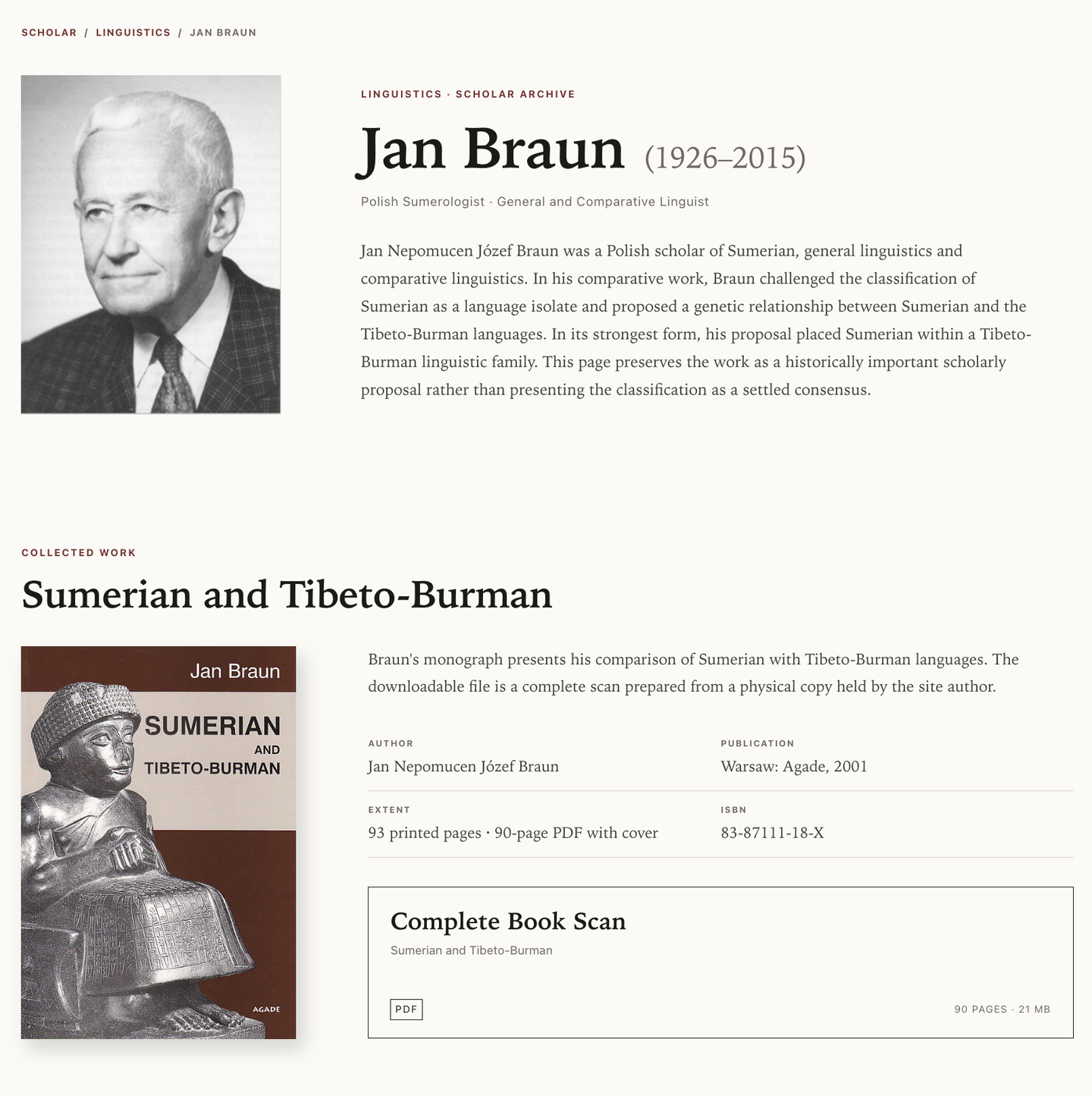
For some scholars, I will also provide PDF copies of their works. These are generally highly obscure books that are difficult to find online and whose printed editions are largely out of print, although some can still be downloaded from established overseas repositories such as the Internet Archive. Because the scholars listed here are relatively little known, I do not consider the copyright risk especially high. Even so, I will publish selectively after considering whether a scholar is still living and assessing the possible risks. My willingness to accept those risks rests on the immense academic value of circulating neglected knowledge.
V. Why I Built the Website
My original purpose in creating this website was not complicated. In the explanations currently offered—whether by independent enthusiasts or by more professionally qualified institutions—I can identify obvious logical errors. If no existing account can adequately explain these questions, then I will try.
Written: September 10, 2026
Original Chinese article: https://zhuanlan.zhihu.com/p/2079696203772699837