The Genetic History of D‑M174

← All ancient samples

AKG_10203

also recorded as Gimhae_KD12

Y-DNA
D-M116.1
mtDNA
D4e2
Major branch
D-M55 (Japanese)
Sex
Male
Site
Daeseong-dong Tomb 12 대성동고분 12호
Region
Gimhae, South Gyeongsang, South Korea
Age
伽倻国 (Gaya)
Culture
Gaya

A Gaya-period elite individual

AKG_10203 was a male individual recovered from a Daeseong-dong burial at Gimhae, within the territory of the Gaya confederacy. The study dates him to 350–500 CE and assigns him to the Korea-TK_2 genetic cluster. His position in a formal burial, contrasted with several individuals identified as sacrifices, supports the study’s interpretation of AKG_10203 as an elite-associated individual.
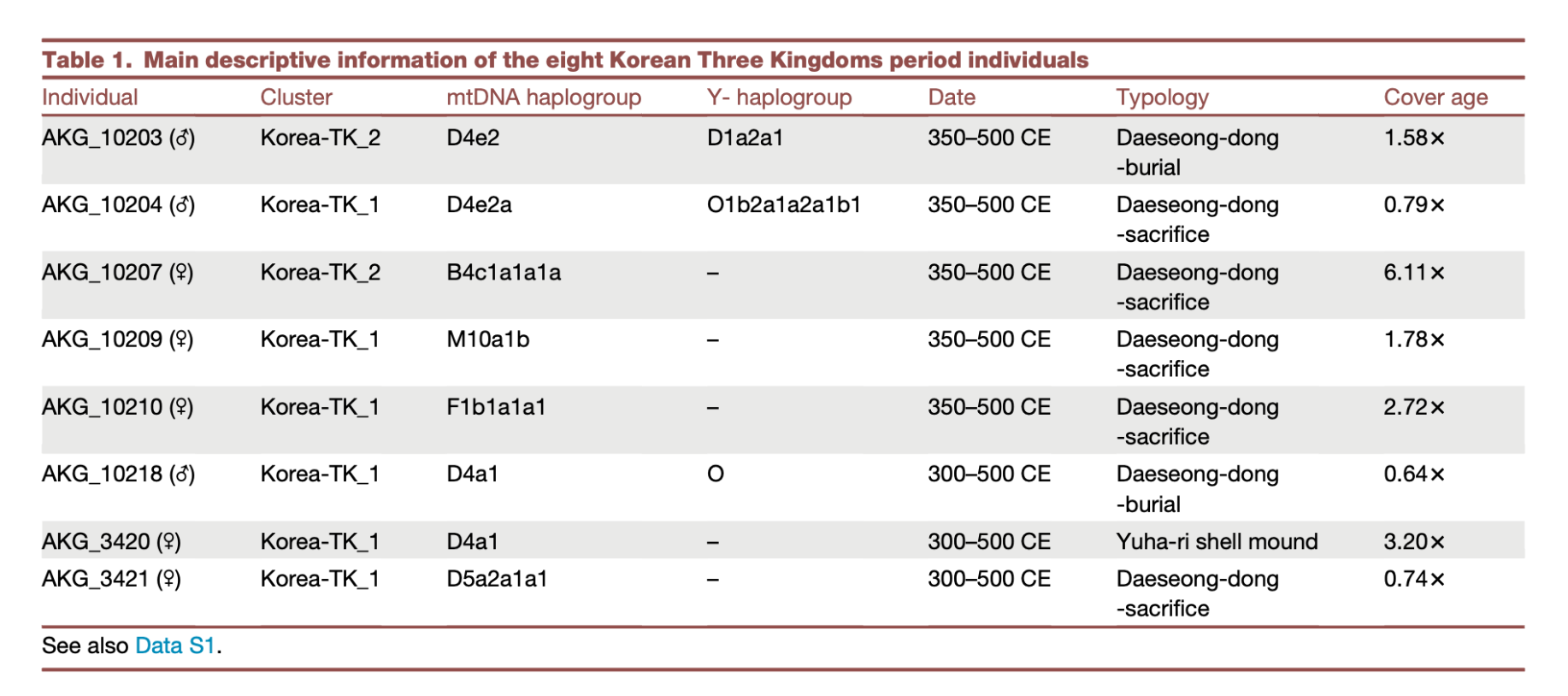
Descriptive information for eight Korean Three Kingdoms period individuals, including AKG_10203
Summary of the eight Three Kingdoms-period individuals included in the study. AKG_10203 is recorded as a male from a Daeseong-dong burial, dated to 350–500 CE, with mtDNA D4e2 and Y-chromosome haplogroup D1a2a1 in the nomenclature used by the original publication. He belongs to the Korea-TK_2 cluster.

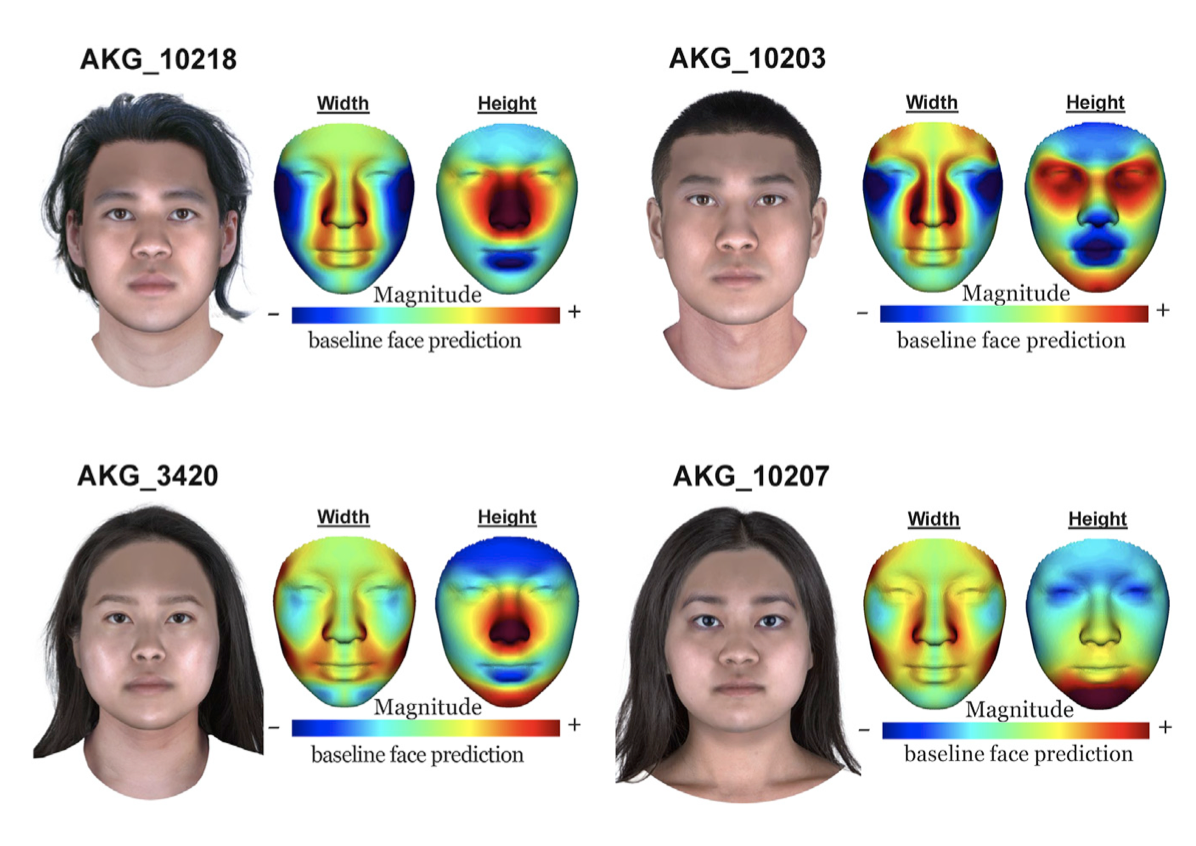
Predicted facial appearance

Genetically predicted facial appearance of AKG_10203 and three other Gaya-period individuals
Genetically informed facial predictions for four individuals from the study. AKG_10203 appears in the upper-right panel; the adjacent width and height maps show the modeled deviations from the baseline facial prediction.

Social grouping and autosomal ancestry
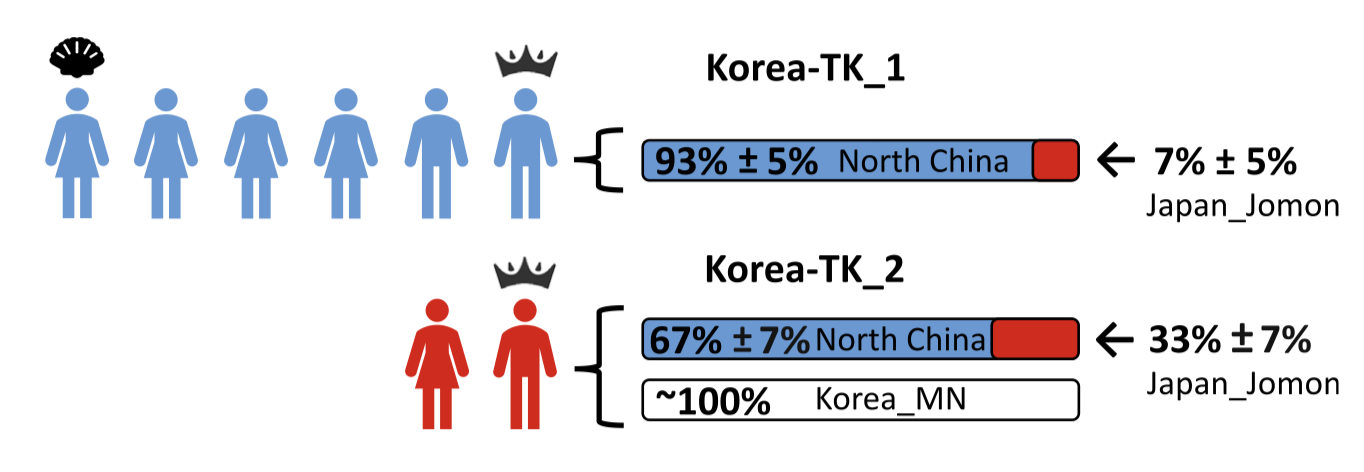
Schematic comparison of social grouping and autosomal ancestry models for Korea-TK_1 and Korea-TK_2
Schematic comparison of the two genetic clusters and their archaeological contexts. Korea-TK_2, which includes AKG_10203, is associated with the elite burials and is modeled as approximately 67% ± 7% North China-related ancestry and 33% ± 7% Japan_Jomon-related ancestry; the figure also presents an alternative model using Korea_MN as the source. These values are population-level models for the cluster rather than direct measurements of AKG_10203 alone.